

How to Make Church Finances Easier: A Guide to the 5 Stages of Growth
I love camping.
I've been going my entire life. However not all camping experiences are created equal.
This year, as I was at Rock Point Provincial Park, I thought back through different stages of camping.

When my husband and I were just married, with our newly purchased tent and new to us items from garage sales, we would freeload on my parent’s campsite. We'd sleep on an air mattress that mysteriously was always flat by morning no matter how firm it was the night before.
Then came young kids, so we invested in our own campsites and a 20 year old tent trailer. Putting a tent trailer up and down always involved playing Tetris, trying to get all the supplies and bags arranged perfectly to fit.
Now, many years later, we own a lovely trailer that's basically a cottage on wheels, with a full bed, fridge, air conditioning and the most wonderful invention of all, a bathroom!
The point is, as we go through life cycles of anything, including camping, there are stages you move through. At each stage there are unique challenges and actions needed to move forward to the next one. Church finances are no different.
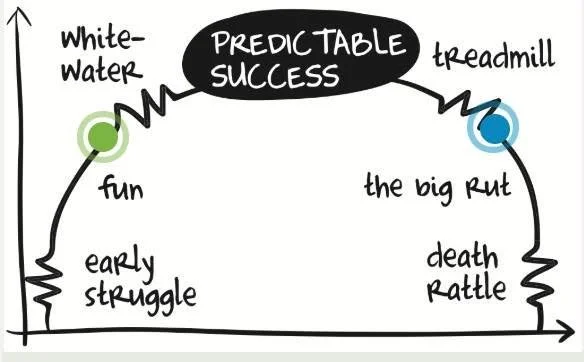
The best context for this concept is to use Les McKeown's book Predictable Success. In it, he talks about the 7 stages organizations go through as they grow and peak and then decline.
And when we start working with a church, I'll ask questions to try to identify which stage a church is in, because their financial needs change depending on the stage.
Below I put together a small guide that will help identify the stage you are in, focusing on your churches finances, and how to move up or down to get to that 'predictable success' peak where finances just 'work'. I'll focus on the first 5 stages.
STAGE 1 - EARLY STRUGGLE
What Does a Church Plant Need to Set Up Its Finances?
This is a church plant. Set up and survival are the goals.
Actions
Get the church registered with CRA so the church can issue tax receipts.
Set up a bank account and have all the funds in the church flow through that account. Meaning, deposit all the cash into that bank account, and pay all the expense out of it. This tracks the in and outs much more effectively then just using cash.
Resources to help
Church plant organizations & support groups.
Launch Point (https://www.launchpointconsulting.ca/) has an online course that can walk a charity through early set up, compliance and training.
STAGE 2 - FUN
How Do I Set Up a Financial System for a Growing Church?
Congratulations, you survived! Now things get fun, there is momentum and energy. More people are giving and more ministries are spending. That means you'll need a financial system in place. A way to track it all.
Actions
If, as a pastor, finances and admin are not your strength, find a treasurer. Have someone own this function. They'll need to enter all financial info at least monthly (preferably weekly) into an excel or bookkeeping software.
Know your numbers. Get a report that shows money in and money out each month. There is a lot of activity happening, but in the beginning it might not translate to money being donated yet.
Set up a CRA payroll account. In this stage, a church will add a pastor as a paid employee. CRA payroll compliance is important and when starting, it's confusing to sort out. Engage a simple payroll software to handle the actual calculations, T4, clergy housing, and monthly remittance of payroll taxes to CRA.
Resources to Help
Bookkeeping Solutions – free download of an excel General Ledger built for churches - https://www.mybookkeepingsolution.ca/resources
Quickbooks Online (QBO) - https://quickbooks.intuit.com/
Wagepoint Payroll Software - https://www.wagepoint.com/
STAGE 3 - WHITE WATER
How Do I Get Control of Chaotic Church Finances?
The success of Fun will lead inevitably to more growth. That growth brings complexity and chaos. Instead of focusing outwards on people, you are constantly firefighting. It's too big and you can't keep everything in your head. Ministries are spending money without approval or a plan, while others are questioning your financial stewardship. This is the stage we, as contract bookkeepers, are brought in.
Actions
Hire an internal bookkeeper, or a contract bookkeeping service. It's too much work for a volunteer, and you'll need the ability to hold your finance team accountable, which is difficult with a volunteer.
Create a budget. A budget is more than a to-do, it's a great way to get everyone on the same page, working in the same direction. It clarifies expectations, expenditure approvals, holds those owing the budget accountable. It also improves reporting which allows the treasurer and pastor to have a great overall perspective of the church’s finances.
Time to invest in software. Donations software like Planning Center Giving (PCO) is scalable and no longer optional at this stage. QBO for General Ledger and reporting and your payroll software like Wagepoint. When you hire a bookkeeper ensure they know the software so you solve problems not just create a patchwork of tech that doesn't work together.
Processes are going to be your best friend. Put simply, this means having clear standards for "how we do things." It might sound boring, but this prevents and solves core problems, rather than always firefighting the symptoms.
Resources to Help
Bookkeeping Solutions – We'd love to help! https://www.mybookkeepingsolution.ca/
Planning Center Giving - https://www.planningcenter.com/giving
STAGE 4 - PREDICTABLE SUCCESS
What Does Healthy Church Financial Management Look Like?
This stage is the goal. This is where goals are met, process is clear, and things just work. And you don't ever need to leave this stage. The trick is to always have that healthy tension between process and people. That involves creating systems that promote (not impede) effective data, debate and decisions.
Actions
The reports you are getting need to make sense. The balance sheet is where bad bookkeeping really shows up. Your bookkeeper should be able to answer and explain all the items on that report. You need good data to make good decisions.
All organizations when operating well are decision making machines. Work at having effective meetings where ideas are brought up, data and problems are analysed, and action steps are taken. Work at making your meetings useful and engaging rather than monologues that no one wants to attend.
Financial committees are often formed in this stage. Handpick the members to be people who know numbers and are aligned with leadership, keeping the group small and ego free. They serve as advisors to the board and/or pastor and often work in the background helping understand reporting. They often suggest ways to improve financial processes.
Resources to Help
Bookkeeping Solutions – We'd love to help! https://www.mybookkeepingsolution.ca/
EOS System – This is the system I use in my own company. It's a cadence of meetings, accountability and follow through - all for purposes of effective goal setting. Useful for all organizations. Start with the books Get a Grip or Traction by Gino Wickman.
STAGE 5 - TREADMILL
What Happens When a Church Has Too Many Financial Systems?
This is the phase that happens if there are too many systems in place. The organization gets clumsy and can't seem to move forward. Everything is a discussion and change is painful and slow if it doesn't just stop altogether.
Actions
“Cut or simplify anything that’s outlived its purpose.”
Refresh your board and/or finance committee. I know this is hard, so hard. But adding in fresh voices can often be the start of change. They can advocate and bring a breath of fresh air to a stale room.
Audit your systems. Sit down and list every report, approval step, and process currently in place. For each one, ask: is this still serving the mission, or has it become a hoop to jump through? Cut or simplify anything that's outlived its purpose.
Create cross-functional committees. Nothing generates ideas like putting together people from different ministries and departments. Instead of finance operating in its own silo, bring in voices from worship, outreach, and administration to look at a process together. Fresh combinations of people surface fresh ideas, and it breaks the pattern of the same small group making all the decisions the same way.
Resources to Help
Consider bringing in an outside consultant who specializes in organizational health, or a church-specific consultant who works with boards and leadership teams. This isn't a bookkeeping problem at this stage; it's a leadership and culture one, and an outside voice can help a stuck system find a way forward.
Death by Meeting or The Advantage, are both books by Patrick Lencioni. He writes specifically about organizational health and dysfunction, and his work is widely used in church leadership circles.
Conclusion
Just like in my camping career (tent to tent trailer to cottage on wheels), church finances moves through growth stages. The goal is to reach that peak of Predictable Success. That's the cottage on wheels, where the systems are dialed in, people are engaged and everything just works.
The good news is you don't have to figure out every phase on your own. First identify the stage you are in and then reach out for support. And there is a lot of support available. At Bookkeeping Solutions, we are also here to walk alongside churches and we'd love to help you find your way to (and stay in) Predictable Success.
Wherever you are on the journey, reach out. We're always happy to talk!